Full Moon Elixirs
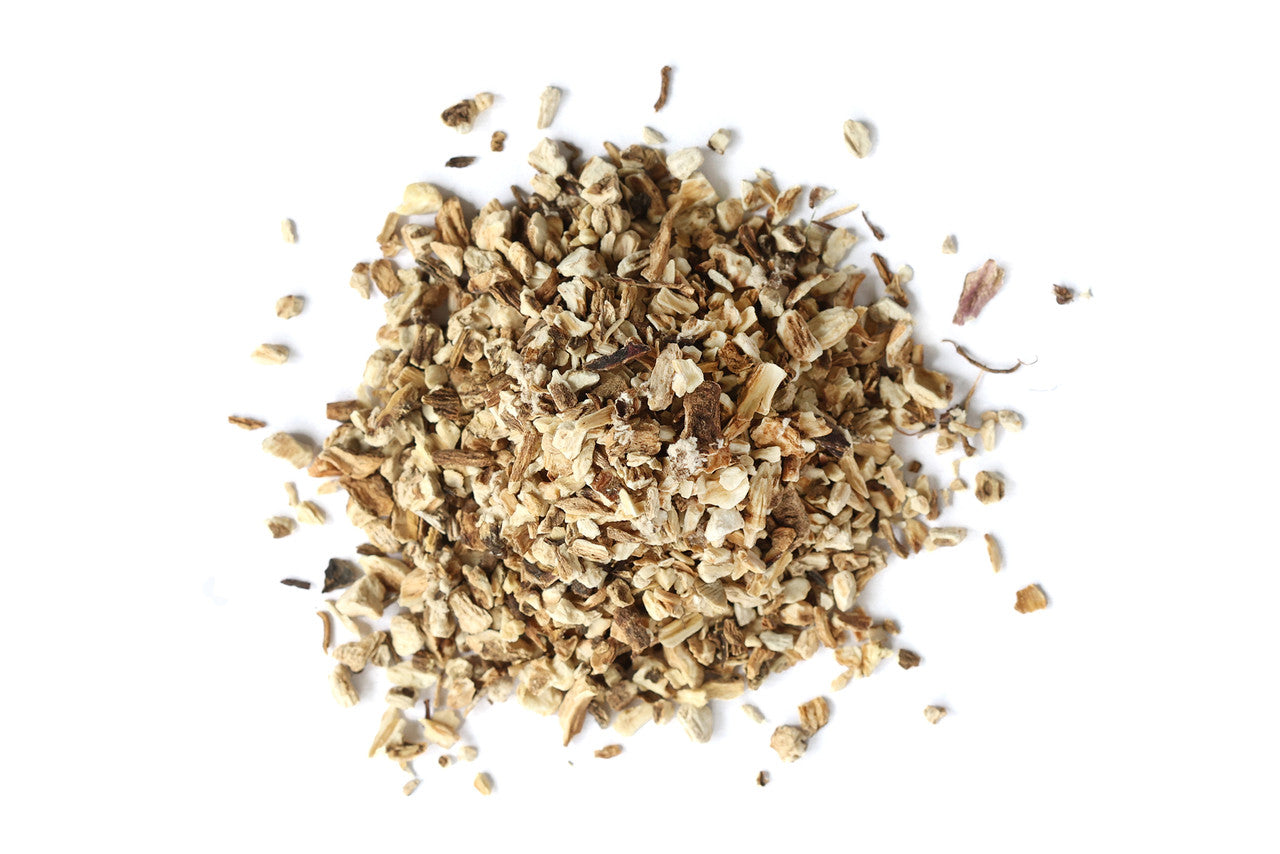
Burdock Root Organic
Burdock Root Organic
Couldn't load pickup availability
Burdock Root (Arctium lappa)
Burdock is a plant that grabs hold of you — sometimes literally. Its seed-bearing burs, covered in tiny hooked barbs, latch onto wool, fur, and fabric with remarkable tenacity, hitching rides to spread themselves far and wide. It was this very grip that inspired Swiss engineer Georges de Mestral, after a mountain walk left his socks and his dog thoroughly decorated in burs, to go home and replicate the mechanism in his laboratory. In 1955, Velcro was patented and introduced to the world — one of history's more delightful examples of nature leading the way.
The names tell the story well. Arctium comes from the Greek arktos, meaning bear — a nod to the rough, fuzzy bur that resembles a small, bristling bear. Lappa derives from the Latin lappare, "to seize." Its common name traces back to the French bourre, a tangle of wool frequently caught with burs, and the German dock, referring to its famously large leaves. It is a plant that announces itself.
Our organic burdock root is cultivated with great care in the Pacific Northwest. A biennial member of the Asteraceae family, burdock is a robust and striking plant — capable of reaching nine feet tall, with enormous, heart-shaped hairy leaves and bright thistle-like flowers in shades of pink-red to purple. Beneath the surface, its aromatic taproot can plunge three feet into the earth, which makes harvesting a genuine undertaking. As the late herbalist Michael Moore memorably observed, harvesting a fully flowered burdock in fall "can be as much work as digging up a small tree."
Burdock has been a cornerstone botanical in both Western folk herbalism and Traditional Chinese Medicine for thousands of years. In TCM it is considered energetically cold with a soothing, slippery quality that calms mucous membranes, associated with the lung and stomach meridians, and valued for its ability to balance internal heat and support skin health. In European folk medicine, Nicholas Culpepper — herbalist, astrologer, and devoted student of the natural world — wrote of burdock in his 1653 Complete Herbal with characteristic warmth, noting its cooling properties and its traditional use as a remedy for serpent bites taken in old wine. As an astrologer, Culpepper considered burdock a feminine plant ruled by Venus, and factored this into his preparations accordingly.
In Native American healing traditions, the Malecite, Micmac, Ojibwa, and Menominee used burdock for skin health, while the Iroquois dried and stored the roots over fire as a winter food source. William Cook, writing in his 1869 Physio-Medical Dispensatory, described burdock as an ingredient in a beneficial spring "family beer" alongside yellow dock, elder flowers, and ginger. Herbalist Matthew Becker calls it "a potent yet safe lymphatic decongestant" that works best as a gentle, restorative alterative over time — its bitter tonic qualities supporting digestion, and its inulin content nourishing the healthy bacteria of the colon.
In Asia, burdock is simply good food. Known as gobo in Japanese, it is a widely consumed vegetable — the root eaten fresh or cooked, the young leaves prepared like any other green, and the stalks, with their mild asparagus-like flavor, enjoyed raw, boiled, or candied. It is a plant that nourishes as much as it heals.
Our burdock root is well suited for cold infusions, decoctions, and tinctures, and pairs beautifully in blends intended to support skin health, digestion, and lymphatic circulation.
Precautions: No known precautions. As with all herbal products, we recommend consulting a qualified healthcare practitioner before use, particularly if you are pregnant, nursing, or taking any medications.
Share